Written by Spring 2025 AFA Intern Franny Daleo-Clark
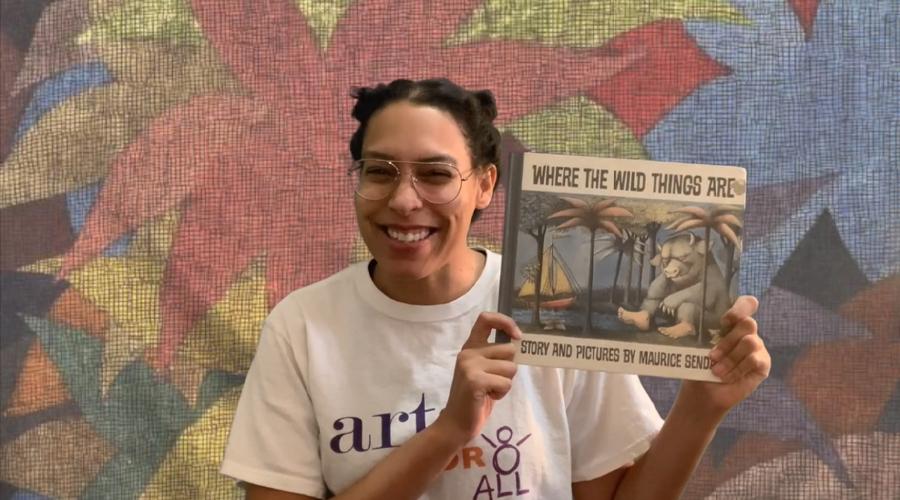
As part of my virtual work through my Arts For All internship, I have been going through and learning from some of the Virtual Classroom video series on Arts For All’s website. This week, I watched a series by teaching artist Mélissa Smith. In this set of videos, she uses Maurice Sendak’s Where the Wild Things Are for an interactive storytelling exploration that promotes literacy learning and artistic engagement, targeted at first graders. I engaged with these videos and got to explore ways that the arts support learning.
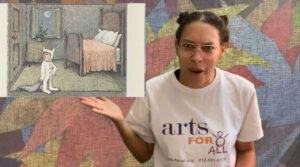 The first part of the series is a read-through, but Smith first opens with an introduction and a physical warm up, having the viewer do some light stretches and isolation movements and then grow tall like branches on a tree while counting, physically preparing our bodies for art but also working on counting skills. After shaking our whole bodies while counting down, she moves into the interactive reading section. Smith reads the story and asks questions while she goes, teaching new words and encouraging movement continually. Doing the read aloud in an interactive format allows for the kids watching to play pretend, and also to imagine what Max’s experience in the story is like. They get to pretend to be monsters or have a “wild rumpus.” Smith’s questions throughout have the kids working on reading and talking, practice critical thinking skills, guessing endings, and working on pattern recognition. After reading the story, Smith walks through a story recap while asking more leading questions. To close out the session, she leads some deep breathing and has the viewers think about a place that they felt loved.
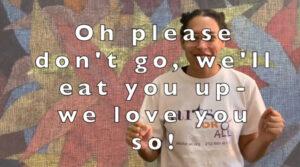 The second part of the series moves into creative making. Smith explains that we will be coming up with our own “wild things” in this session, but first she re-introduces the warm-up from part one. Then, she does a story summary of Where the Wild Things Are to review the book collectively. She introduces the concept “wild things” and teaches the viewers how to look for textual clues to figure out what a wild thing looks like. We look for textual clues and in the pictures. Some have feathers, horns, yellow eyes, claws, and so on. She prompts us to imagine having these attributes on our own bodies, like scales or feathers, encouraging imagination, and then tells us to pause the video to draw our own wild thing. Then, she has us come up with our own “wild thing” voice and has us practice saying the line, “Oh please don’t go, we’ll eat you up I love you so!” Smith says we can also give them names. For the closing, she encourages us to think about something unique about ourselves, just like the wild things are all unique and individual and then leads some deep breaths.
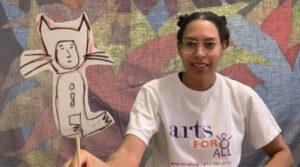 In the third section of the series, Smith begins with the same, familiar warm up and does another story recap. The main activity is making our own wild thing puppets! In the video itself, though, Smith simply walks kids through the planning process and invites us to think about what our creative process will look like. Once we make wild thing puppets, Smith invites us to make any other puppets useful in telling the story, like waves, a boat, or other characters, using whatever materials are accessible. She reminds the viewer that there is no right or wrong way, encourages us to be as wild and creative as we’d like, reminding us that the puppet does not have to be perfect, it just has to bring you joy! It is a good reminder to try and take the pressure off artmaking; it’s supposed to be fun and supportive of learning! For the closing of this session, Smith leads deep breaths again and asks us to envision what our puppets will look like. Then, she releases the viewer to start making! I had fun with this activity and let my imagination run wild, as I’m sure many of the kids watching do as well.
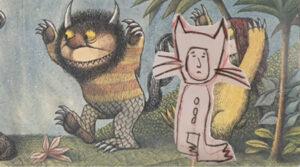 In part four, the viewers start the session having made their puppets. Smith leads another warm-up and then starts the rehearsal process of telling the Where the Wild Things Are story with our puppets. She leads kids through making ocean sounds, growing like a tree, throwing a “wild rumpus,” pretending to sleep, and practicing their line. Then, it’s showtime! Smith reads the book one more time, prompting viewers to act out the narrative with their puppets. It’s very interactive, allowing kids to use their voices, bodies, and puppets to tell the story while developing literacy and emotional skills. At the end of the session, Smith closes by encouraging the viewers to talk to someone about something they themselves did really well during the process, and what someone else did well during the process if they were participating collaboratively. This was a great culmination of the four-part series! I had fun using my imagination to make my puppet and to consider all the benefits of using the arts in a format like this one for literacy learning. This series is just one of many on the Arts For All website that uses arts-based activities to help kids develop literacy skills, social-emotional skills, and more, so I encourage you to check them out, both with a child or on your own!